Originally sent to The Blue Card email community on November 10, 2021.
How to Help Holocaust Survivors
by Masha Pearl
For the large majority of the estimated 65,000 Holocaust survivors living in the United States and the 300,000 Holocaust survivors worldwide, even as we come out of the COVID-19 pandemic, it continues to be a time of loneliness. Thousands continue to fight to protect their basic health as they are forced to remain isolated due to the severity of their medical conditions.
As the occasion of the 83rd anniversary of Kristallnacht is upon us — that moment when anti-Semitic rhetoric and legislation turned incredibly violent, with the destruction of Jewish businesses, synagogues, homes and more — it is more important than ever for us to take care of this precious community and their extensive needs, from health care to financial assistance.
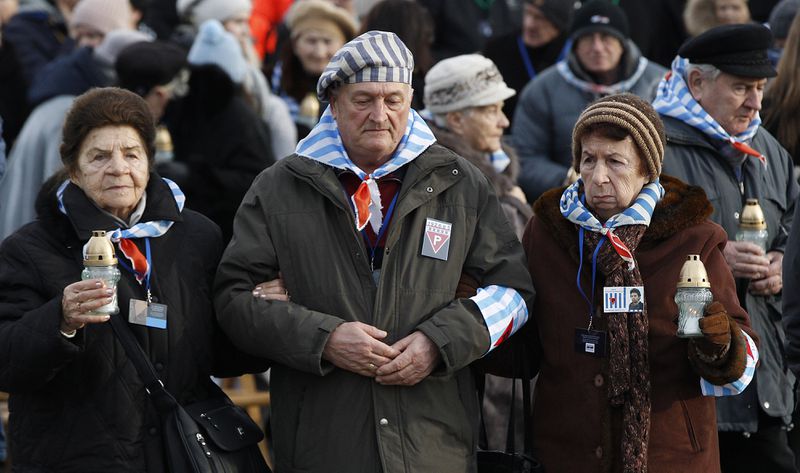
In this Sunday, Jan. 27, 2019 file photo, survivors of the Nazi death camp Auschwitz arrive for a commemoration ceremony on International Holocaust Remembrance Day at the International Monument to the Victims of Fascism inside Auschwitz-Birkenau in Oswiecim, Poland. (Czarek Sokolowski/AP).
There are tens of thousands of Holocaust survivors living at or below the poverty level in the New York City metropolitan area alone, and this does not include survivors outside of networks and organizations. Studies have found that Holocaust survivors face a higher rate of chronic and acute illness, including cancer and heart disease, from years of exposure to severe famine and stress during the war.
Nearly three-quarters of Holocaust survivors live alone; 67% cannot leave home without assistance, and 69% live on less than $25,000 annually. Studies have proven, Holocaust survivors also experience a documented and substantially higher incidence of life-threatening diseases: 14% higher rates of cancer for women and 21% higher rates for men. In addition, many have no family and live extremely isolated lives.
The most immediate and critical needs of Holocaust survivors today include emergency cash assistance for food, help with medical bills and rent costs, home care programs, and emergency alert systems to ensure their safety and help them live out their final years with dignity. Due to gaps in eldercare, and because of the constant Medicaid and food stamp cuts, Holocaust survivors are finding themselves in situations that are seemingly more difficult to bounce back from.
The organization I lead, The Blue Card, exists to ensure Holocaust survivors in need are cared for, financially and otherwise.
Established in Germany in 1934 as a grassroots effort and re-established in the United States in 1939 to aid refugees resettling in America, we continue today to provide direct financial assistance to needy Holocaust survivors who live at or near the poverty line. As this population ages, with many now living into their 80s, 90s and some over the age of 100, their needs have drastically increased and changed, giving rise to the need for funding of essential needs.
On this occasion — 83 years after these horrific events — we must come together not only as a community, but as a nation, with a renewed sense of commitment to helping Holocaust survivors.
Sincerely,

Masha Pearl
Executive Director
Now, in their late 70’s, 80’s, 90’s and many over the age of 100 years old, Holocaust survivors rely on outside help more than ever. Please help us carry out our time-sensitive mission.

The Blue Card | T: 212-239-2251 | F: 212-594-6881 | bluecard.org
Learn more about how The Blue Card helps or how to apply for assistance.